
The Village We’ve Lost and How to Rebuild It
Parents today have access to more information than ever before. We can find an answer within seconds. Yet many of us are raising children with remarkably little day-to-day support.
Somewhere along the way, we bought into the lie that a successful mother should be able to do it all: nurture our children, manage a household, build a career, maintain friendships, care for aging parents, remember every permission slip, schedule every appointment, prepare healthy meals, and somehow find time for ourselves.
It should be no surprise it’s taking a toll.
The 2026 State of Motherhood report found that nearly 60% of millennial mothers believe their household would fall apart within two days if they stepped away. More than half say they are responsible for tracking the family’s schedules, while nearly half spend much of their time reminding everyone else what needs to be done.
Perhaps most telling, when mothers were asked what they needed most, the top answers weren’t more productivity tools or smarter technology. They wanted more personal time to rest, more help from family members, and less responsibility to carry alone.
The Village We’ve Lost
Long before researchers were studying parental burnout or the mental load of motherhood, anthropologist Jean Liedloff observed something similar while living with the Yequana people of South America. In The Continuum Concept, she described children growing up surrounded by people of all ages while adults naturally shared the work of everyday life. Babies were held by many loving arms. Older children learned by watching and participating alongside adults. Meals, work, conversation, and caregiving flowed together rather than being divided into separate compartments.
Whether or not every aspect of the Continuum Concept resonates with modern families, one idea feels especially relevant today: Humans were never meant to parent alone.
For most of human history, community wasn’t something people had to create. It simply existed.
Children wandered between grandparents, cousins, neighbors, and family friends. Adults cooked together, worked together, celebrated together, and supported one another through difficult seasons. Parenting wasn’t the responsibility of one or two exhausted adults trying to meet every need.
Today’s families often live far from relatives. Neighborhoods can be friendly but they might not always feel truly connected. Work schedules pull us in different directions, and children’s calendars quickly become filled with organized activities that leave little room for simply being together.
Many parents describe feeling lonely despite being surrounded by people.
Perhaps that’s because what we’re missing isn’t more social media followers or another group text. We’re missing shared life. Without realizing it, we’ve normalized a way of parenting that asks one or two adults to do what entire communities once shared.
Why Community Helps Regulate Our Nervous Systems
When we’re overwhelmed, it’s easy to begin viewing relationships through the lens of scarcity. As nervous system educator Sarah Tacy explains, when we’re under-resourced, we tend to keep score.
We notice who changed the most diapers. Who emptied the dishwasher. Every interaction with our partner or the few people we can rely on can start to feel like one more thing we’re carrying.
But community offers something our nervous systems have always needed: the feeling that we don’t have to face life alone.
Simply knowing there’s someone you could call if your child gets sick, your car won’t start, or you need an hour to yourself changes the way your body experiences the world. You may never need to make that phone call, but the knowledge that support exists reduces the need to constantly brace for every possible challenge on your own.
Over time, dependable relationships become a kind of shared resilience. Instead of carrying every responsibility by yourself, your nervous system learns that help is available, burdens can be shared, and difficult seasons don’t have to be faced in isolation. That sense of safety doesn’t just benefit parents. Children begin to experience it too, growing up surrounded by adults who remind them they belong to something larger than their immediate family.
Community Is Built in Ordinary Moments
Writer Teresa Pitman and her friend Vicki didn’t create an elaborate parenting group or schedule perfectly planned playdates. Instead, they folded each other into everyday life. They prepared meals together, tackled household chores side by side, and let their children play nearby while the adults simply lived their lives.
It wasn’t until years later, after reading The Continuum Concept, that Pitman realized they had unintentionally recreated something remarkably close to the kind of community Liedloff described.
She reminds us that community doesn’t have to be complicated. Sometimes it looks like inviting another family over for homemade soup, even if your house isn’t perfectly clean. Maybe it means asking a neighbor if they’d like to join you for an evening walk. Sometimes it’s gardening together while the children collect worms and build imaginary worlds nearby.
The point isn’t to entertain each other. It’s to share ordinary life.
Children benefit from watching adults cook, fix broken things, care for gardens, laugh over dishes, and solve everyday problems together. They learn that life isn’t divided into “adult time” and “kid time.” They belong within the rhythm of family and community life.
And perhaps just as importantly, parents begin to feel like they belong again, too.
Building the Village We Need
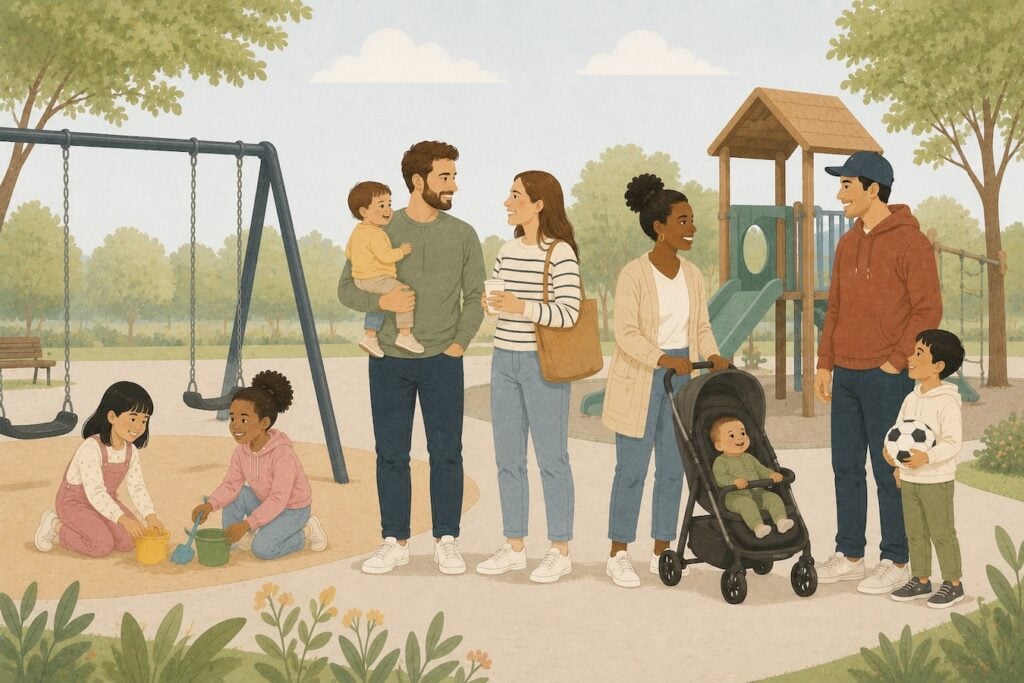
The beautiful thing about community is that it rarely appears all at once. It grows slowly and you find it in the family you see regularly at the park or the neighbor who brings over tomatoes from their garden.
These small moments may not look like the villages of generations past, but they offer something remarkably similar: shared responsibility, genuine connection, and the comforting reminder that we’re not carrying everything alone.
You don’t need friends who parent exactly the way you do. In fact, some of the richest communities include people of different ages, backgrounds, and life experiences. What matters most is mutual respect, kindness, and a willingness to show up for one another.
Sometimes community grows because someone simply creates space for it. Natalie Cronin started a daycare in her home that began to resonate with others in her community.
“I share my home with a dozen families a day, and we have a saying that ‘We’re all in it together.’ We aren’t caring for just the child, we’re here for the whole family, and that’s really what it’s become.”
“Our community has become so close. The parents contact each other after daycare, and we all live within a few blocks of each other. I have six families who live in the same apartment building as I do. So we really do have our own little community and we’re very supportive of each other.”
10 Ways to Build Your Village
- Become a regular somewhere. Visit the same park, library storytime, babywearing group, church, or farmers market often enough that familiar faces become friends.
- Share ordinary life. Instead of waiting until your house is spotless, ask another family over for pizza or tacos.
- Work alongside each other. Garden together, cook together, fold laundry while the kids play, or tackle home projects instead of planning elaborate activities.
- Accept help when it’s offered. Many of us are better at giving than receiving. Letting someone bring a meal or pick up your child from practice strengthens relationships rather than burdening them.
- Offer help without keeping score. Drop off soup, watch a friend’s kids for an hour, or share extra vegetables from your garden. Community grows through generosity, not transactions.
- Connect across generations. Grandparents, older neighbors, retired teachers, and family friends all have something valuable to offer children — and often appreciate being included.
- Find people with shared values, not identical parenting styles. You don’t have to agree on every parenting decision to build meaningful friendships.
- Use the internet as a doorway, not the destination. Local Facebook groups, library calendars, nature clubs, and community events can help you find people to connect with in person.
- Leave room for unstructured time. Some of the best conversations happen after the soccer game, while kids ride bikes, or during an unplanned evening on the porch.
- Start with one relationship. You don’t need a whole village overnight. One trusted family can make an enormous difference.
When Family Is Your Village
For some families, community begins at home.
As housing costs have risen and childcare has become increasingly expensive, multigenerational living has become more common again. Today, nearly one in five adults ages 25 to 34 lives with parents or grandparents, and many families are discovering benefits that go far beyond saving money.
“It was nice to rediscover a relationship with my parents as a parent. I don’t think our vision was ever, oh, let’s go live with our parents again when we are older. But it worked out,” shares Kasey Turner, a mother of two. Everyday responsibilities like sharing meals, helping with school pickups, and simply having another trusted adult nearby made family life feel lighter.
Of course, living with or near extended family isn’t possible for everyone. Some families and siblings are scattered across the country, and some have relationships that aren’t healthy enough for close daily involvement.
But whether your village is made up of grandparents, neighbors, close friends, or the family you choose along the way, the principle remains the same: parenting becomes a little lighter when it’s shared.
The Cost of Community Is Sometimes Inconvenience
Real community isn’t always convenient.
Before ride-sharing apps, getting to the airport often meant asking a friend, neighbor, or family member for a ride. Maybe they said yes because you watered their garden or fed their cat the last time they were away, or because they knew you’d do the same for them someday.
Most of the strongest communities have always worked this way. People interrupt dinner to help jump-start a car. They bring soup after surgery. They watch a friend’s children for an afternoon. Not because it’s efficient, but because relationships grow through ordinary acts of showing up.
In a culture that prizes independence, inconvenience can feel like something to avoid. But perhaps it’s better understood as the price — and the privilege — of belonging.
When we allow ourselves to be needed, and when we’re willing to need others, we create the kind of mutual support that helps everyone feel a little safer.
Community Looks Different for Every Family
Community doesn’t have to look like a perfect neighborhood where everyone knows each other’s names. It might be one trusted friend who always answers your text. A grandparent who comes over every Thursday. Neighbors who wave from the driveway. A family you met at the park who now feels like old friends.
The village isn’t built all at once. It’s built one shared meal, one conversation, one favor, and one ordinary afternoon at a time. And those small moments may be exactly what both parents and children have been needing all along.