
How Active Outdoor Play Leads to Less Screen Time
Editor’s note: Encouraging more screen-free outdoor play doesn’t have to mean another battle over screen time. One dad shares how a simple backyard activity helped his daughter choose active play on her own.
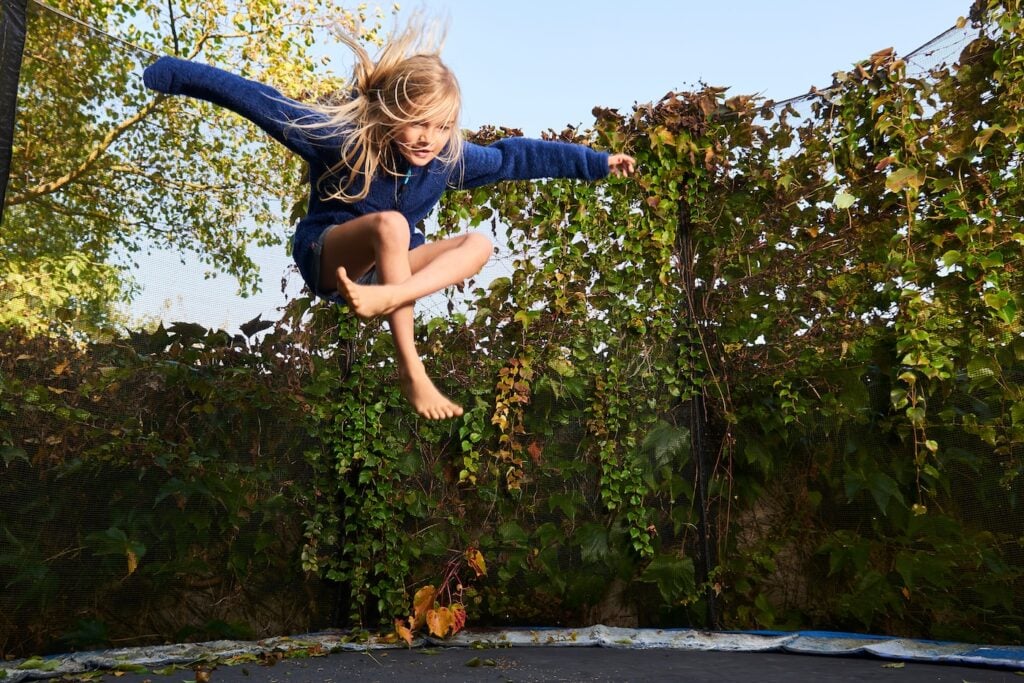
My daughter loves being outside, but getting her there used to be a negotiation. She’s seven, and by late afternoon most afternoons she’d have drifted toward the couch and the tablet, half-asleep with her thumb on a screen. I tried the usual things.
A basketball hoop she used twice.
A sandbox that became a cat toilet.
Sidewalk chalk and a swing set that mostly held up the laundry.
Then we got a trampoline, and something shifted that I did not expect.
She uses it every single day. Not because I ask her to, and not because it’s a special occasion. She drops her bag by the back door after school and bounces. Sometimes for ten minutes, sometimes for an hour with a friend from down the road. It’s the one piece of backyard equipment she uses on her own, with no prompting from me and no reward attached.
Why Kids Keep Coming Back to the Trampoline
Most outdoor gear needs a grown-up to start it. Someone has to bowl the ball or push the swing. A trampoline doesn’t. A kid can head outside and start bouncing without needing a parent to organize a game or explain the rules. There’s no skill to learn first and no one else required. She just goes.
That matters because the competition is a screen, and a screen asks nothing of a tired child. It’s right there and it needs zero effort. If getting outside means a whole production, the screen wins every time. The trampoline is one of the few things in our yard that’s easier to start than picking up an iPad, and after school, easier usually decides it.
How Bouncing Supports Balance and Coordination
Jumping burns off energy, but it does more than that. When a child bounces, she’s flooding two sensory systems that are still developing. The vestibular system, which sits in the inner ear and governs balance, gets a steady workout every time her body rises and falls. The proprioceptive system, her sense of where her limbs are in space, fires with every landing. Occupational therapists lean on both of these for a reason, and a trampoline delivers them in a form kids will actually repeat.
There’s coordination involved, too. To keep bouncing in one spot, she has to use both sides of her body together and correct her balance a hundred times a minute without thinking about it. That’s real motor development, dressed up as play she’d do anyway.
And then there’s the plainest benefit of all. After a day of sitting still in a classroom, a child needs to move hard before she can settle. Harvard Health has written about how regular physical activity helps kids sleep better and steady their moods, and I can watch it happen in real time. Twenty minutes of bouncing and my daughter is calmer at dinner and more herself by bedtime. The trampoline gives her somewhere to put the day.
The Screen-Free Habit Forms Itself
What surprised me most is that I never had to enforce this. I didn’t build a chart or set a timer or make bouncing a condition of anything. The habit built itself, because the trampoline is more fun than the alternative and it’s fifteen steps from the back door.
That’s the quiet reward of the right piece of equipment. You don’t have to police screen time if the thing outside is more appealing than the thing inside. She chooses it, most days, and choosing it is worth far more than being told to.
What to Look for in a Backyard Trampoline
Choose one that lasts, so it becomes a habit and not a novelty.
Here’s where it can go wrong. A cheap trampoline that sags or rips after one winter becomes a chore you eventually drag to the curb, and the habit dies with it. If you want your kid bouncing every day for years, the trampoline has to survive years.
The features that matter most are often the ones you only notice when they fail: a sturdy, well-secured enclosure net and a weather-resistant frame that can withstand years of outdoor use.
If you want one built to survive years of daily, all-weather use rather than a single summer, Vuly trampolines are worth a look. The Australian company has made backyard play gear for more than a decade, and its Thunder range swaps the traditional coil springs for a springless leaf-spring system, which takes away the pinch points that cause a lot of minor trampoline injuries. Its frames use double-galvanized, weather-resistant steel built to sit outside through the seasons, and the enclosure nets are designed to hold a bouncing kid on the mat rather than sag against the poles.
Whatever you buy, check two things before you commit: how the net attaches, and what the warranty actually covers. Those tell you whether you’re buying a daily habit or a one-summer novelty.
When Screen-Free Play Becomes Second Nature
Months in, the trampoline has become the place my daughter’s friends gather, and where she ends up on her back looking at the sky between tricks she’s proud of. None of that happens on a screen. She’s outside and moving, and she got there on her own.
For a parent trying to loosen the grip of the tablet without turning every afternoon into a fight, that’s about as good as it gets.