
How to Identify 3D Printed Food in Stores
It might sound like something from a sci-fi novel, but 3D printed food is here. From plant-based meats to experimental snack bars, food manufacturers are exploring new ways to create familiar foods using 3D printers.
As these products become more widely available, you’ll likely want to know how to tell tell if something in your grocery cart was 3D-printed. Here’s what we know so far about the labeling process.
What Is 3D-Printed Food?
Unlike traditional food preparation, 3D food printing uses machines to build edible products layer by layer.
“The idea is that you load up a 3D printer with printable inks,” explains Hod Lipson, professor of innovation at Columbia University. “These ‘inks’ are edible ingredients made into gels, pastes, liquids and powders, which are extruded through the nozzles.”
These edible materials can include vegetable purées, proteins, starches, chocolate, and other ingredients. The printer deposits them in precise patterns to create a desired shape or texture.
In plant-based meat production, these ingredients can include soy or pea proteins, plant-based fats, starches, and flavorings. By controlling how the ingredients are arranged, manufacturers can create fibrous textures and marbling designed to resemble animal meat.
3D-printed plant-based meat is different from lab-grown or cultivated meat. The latter involves growing animal cells outside an animal, while plant-based alternatives are made primarily from plant ingredients. 3D printing refers to the manufacturing method and not the source of the ingredients.
3D-Printed Plant-Based Meat Is Entering U.S. Stores
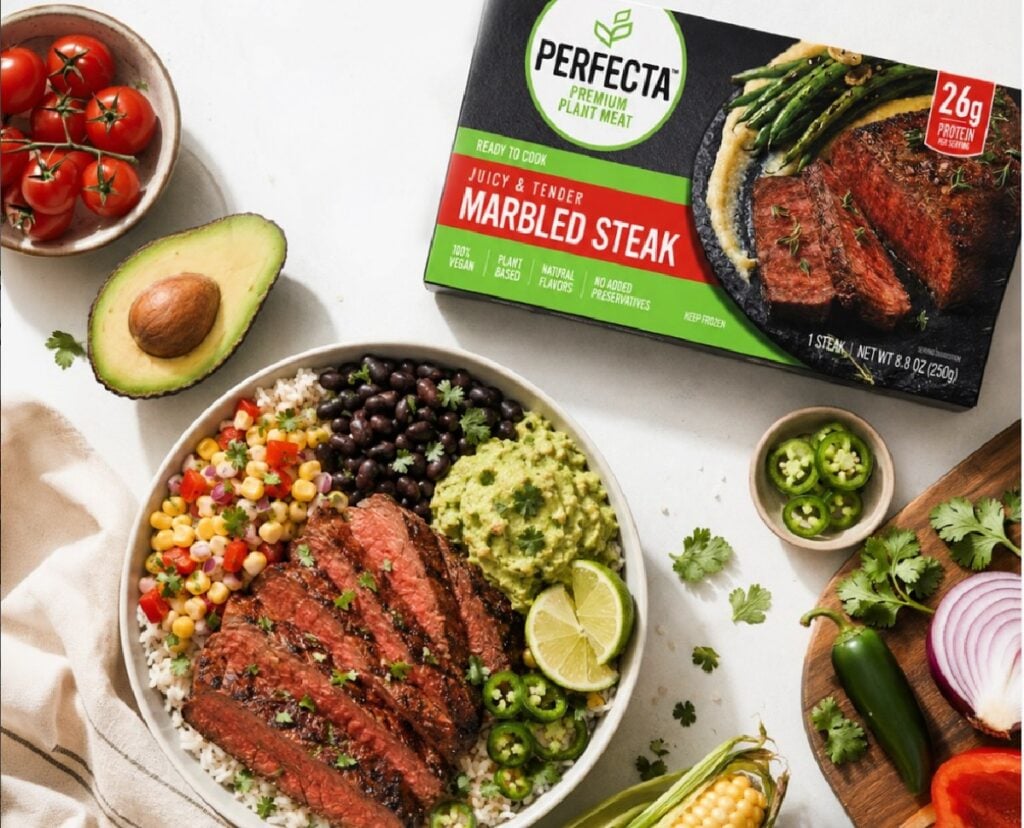
In September 2026, Israeli food technology company Steakholder Foods announced the U.S. retail launch of its Perfecta line of plant-based meat alternatives.
The initial lineup includes:
- Plant-Based Marbled Steak
- Plant-Based Filet Mignon
- Plant-Based Chicken Breast
- Plant-Based Salmon Patties
- Plant-Based White Fish Patties
The company announced an initial rollout in the northeastern United States, with plans to expand distribution.
According to an October 2026 report, the products’ packaging does not explicitly identify them as 3D-printed. The publication also reported that specific retail availability was difficult to verify.
How to Identify 3D-Printed Food
This raises an important question for families who care about how their food is made (and for those of us who want to avoid it): How do we spot it?
Look for Alternative Terms on Food Labels
Food packaging won’t explicitly say “3D-printed.” Instead, manufacturers may use technical or marketing language to describe how their products are made.
Look for terms like:
- 3D-architected
- Structured or matrix-structured
- Whole-cut technology
- Layer-by-layer crafted
- 3D-structured
- Precision-layered
- Digital food fabrication
- Additive manufacturing
These terms can offer clues about a food’s manufacturing process, particularly with plant-based meat alternatives. However, not all of them necessarily indicate 3D printing. For example, whole-cut technology and structured proteins can also be produced using other manufacturing methods.
Another option is checking the ingredients. Perfecta lists plant proteins such as soy or wheat protein, and every product in the range contains the plant-based binder methylcellulose.
Check the Ingredients and Manufacturer
An ingredient list alone cannot confirm whether a food was 3D-printed. Ingredients such as pea protein, soy protein, starches, oils, and binders are also commonly used in conventionally manufactured plant-based foods.
Likewise, labels such as “plant-based,” “vegan,” and “meat alternative” don’t tell you whether a food was printed.
If you’re curious about a particular product, visit the manufacturer’s website or contact the company directly. Product descriptions and manufacturing information may provide details that aren’t included on the packaging.
As for us, we’ll be continuing to support our local farmers when possible, especially those who practice regenerative agriculture.