
Metabolic Foundations Checklist for Shifting Hormones
If you live in a female body, you’re familiar with cycles.
Our monthly cycle is just one reflection of the larger seasons of our lives — adolescence, reproductive years, postpartum, perimenopause, menopause, and beyond. And with each season comes shifting hormones and subtle changes in how our bodies use energy.

Supporting Energy, Weight, and Mood – Postpartum Through Perimenopause
As someone with a 20+ year interest in natural and healthy living, I’ve worked with, interviewed, and been coached by professionals in nutrition, hormones, Quantum Biology, and Neurosomatics.
Their work has been incredibly helpful for my inner nerd. But like most things in wellness, it can also be a bit overwhelming. I tend to oscillate between gathering an overwhelming amount of research… and throwing said information in the air and trusting my instincts.
For me, it’s easy to get lost in a stack of books and half a dozen course logins filled with links, PDFs, and “start here” modules.
So after experimenting with many of the suggestions (and paying attention to what made a difference for me) I created a daily checklist to follow. It lives in my Notes app, and because I’ve been following some version of it for almost two years, it feels pretty sustainable.
When What Used to Work… Stops Working
Some women become very aware of their hormones during fertility journeys or postpartum recovery.
Aside from mild postpartum anxiety, my physical recovery after two births was relatively smooth. I followed my 80/20 approach to mostly organic food and stayed active. I never paid much attention to blood sugar, protein targets, or meal timing.
For years, that was enough.
So I was a little caught off guard when, after turning 42, things started to feel different. My clothes fit differently, but more than that, my energy felt less predictable, cravings were louder, and stress hit harder.
What once felt effortless suddenly required more attention.
It took a while for me to learn that if what used to work for your body no longer works the same way, it isn’t a lack of discipline. It’s physiology adapting.
Hormones shift after pregnancy and birth, and they shift again during perimenopause. In both seasons, many women notice changes in appetite, energy, sleep, and how their body responds to food.
Estrogen, progesterone, cortisol, prolactin, and insulin are all connected. When one changes, the others adjust. Instead of pushing harder or trying to out-discipline your body, it helps to support the foundations more intentionally.
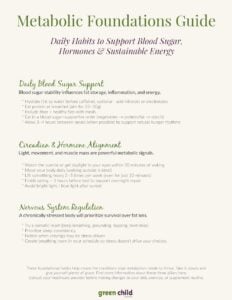
That’s what this checklist is built on. You can download it here or by clicking on the image to the right.
Here is more information on the science behind the steps outlined in the checklist.
1. Daily Blood Sugar Support
Blood sugar stability affects energy, cravings, and how easily the body stores or uses fuel. When it’s steady, everything feels more manageable. When it’s not, the body has to work harder to compensate.
During hormonal shifts, blood sugar can become more sensitive. You might notice bigger energy dips, stronger cravings, or that it takes less to throw things off than it used to.
When the body isn’t receiving consistent fuel throughout the day, it often relies more heavily on stress hormones (particularly cortisol) to maintain energy. Cortisol can raise blood sugar temporarily by releasing stored energy into the bloodstream, which helps in the short term.
But when the body depends on cortisol as a primary fuel source, it starts to feel taxing. Many people describe feeling wired but tired, very hungry later on, and exhausted in the morning.
Supporting blood sugar throughout the day reduces the need for the body to rely on stress hormones for energy.
Here’s what helps:
Hydrate first.
Starting the day with water before caffeine supports digestion, circulation, and more stable energy. Even mild dehydration can increase cortisol and make hunger feel more intense.
Prioritize protein at breakfast.
A protein-rich breakfast helps stabilize blood sugar and reduce cravings later in the day. It also supports satiety signals, which can feel less reliable during hormonal transitions.
Build balanced meals.
Including fiber, healthy fats, and protein at each meal slows how quickly glucose enters the bloodstream. Eating vegetables first, followed by protein and fat, then starch, can help reduce spikes.
Allow time between meals.
When possible, giving your body a few hours between meals supports natural hunger rhythms. This doesn’t need to be rigid, but constant grazing can keep blood sugar elevated.
Walk after meals.
Even a short walk after eating helps the body use glucose more efficiently. This is one of the simplest ways to support blood sugar without overthinking it.
2. Circadian & Hormone Alignment
Hormones don’t operate in isolation. They respond to light, movement, and daily rhythms.
Getting natural light in the morning helps regulate your circadian rhythm, which affects sleep, cortisol timing, and even insulin sensitivity. It’s one of the most overlooked metabolic tools.
To be 100% transparent, strength training is the only thing I struggle to follow on my own list. After 18 months and a handful of injuries in Pilates class, I don’t have the confidence I’m doing it safely. So this is still a work in progress for me.
That said, lifting something heavy-ish a few times per week supports muscle mass, which improves how the body handles glucose. Any type of daily movement helps regulate both energy and mood.
Meal timing can also make a difference. Finishing meals a few hours before bed gives your body space to shift from digestion into repair. At the same time, this is about rhythm, not perfection — especially during seasons like postpartum, when your body’s needs may feel different.
3. Nervous System Regulation
A chronically stressed body prioritizes survival over everything else.
When cortisol stays elevated, the body becomes more likely to store energy and less likely to feel calm, steady, or regulated. Cravings increase, sleep is disrupted, and it becomes harder to feel in control of appetite and energy.
This is why willpower alone doesn’t work.
Supporting the nervous system helps shift the body out of a constant stress response and into a state where it can actually use energy more efficiently. Here are a few of my favorite nervous system tools. The best part is they require no equipment and offer results in usually less than a minute.
Washing machine
Cross body motion activates communication between the brain’s left and right hemispheres. Stand with your arms loosely at your sides. Then twist your body at the hips and let your arms and hands flop gently against your body.
Humming
Humming activates the vagus nerve, which can help shift the body from fight-or-flight mode to rest-and-recovery mode. Take a deep breath and slowly exhale as you hum a single note or your favorite song.
Butterfly hug
This is a reader favorite from our somatic exercises for kids. Cross your arms over your chest to hug yourself. Each hand should be a little below the opposite shoulder. Then, with deep breaths, tap your hands simultaneously on your upper arms/shoulders.
Heel drop
With a straight spine, stand up on your toes and then gently let your weight fall back onto the heels of your feet. This shouldn’t be a jarring motion, but you should feel some force of your body weight into your heels.
Dancing
Does anything bring you back into your body faster than dancing? A spontaneous dance break is one of the best things you can do to release anxiety. It’s also a great way to change up the energy if your kids are low or sulky.
Sleep plays a role here as well. It’s one of the most important times for metabolic reset, and even small improvements in consistency can support hormone balance.
Where Supplements Fit
Once these foundations are in place, some women choose to add additional support, especially if appetite, cravings, or energy still feel inconsistent.
This is where plant-based GLP-1 support has become more interesting. GLP-1 is a hormone involved in satiety and blood sugar regulation, and supporting those pathways can make it easier to feel satisfied and maintain steady energy.
Balance & Burn is one option I’ve been using. It’s not a replacement for these foundations, but for some people, it can help support them.
If you’re curious, you can read more about it and read reviews (updated monthly) here.
A Sustainable Approach
If there’s one thing I’ve learned, it’s that consistency matters more than intensity.
An 80/20 approach allows flexibility without turning every choice into a decision point. Tracking how you feel (energy, mood, and cravings) gives more useful feedback than focusing only on weight.
And in case you missed the link to the checklist above, you can find it here.