
Baby Swim Lessons: What to Expect + How to Choose the Right Class
Wondering if your baby is ready for swim lessons? Here’s what to expect from your baby’s first experience in the water, how to choose the best class, and how to help your child build confidence in and around water.
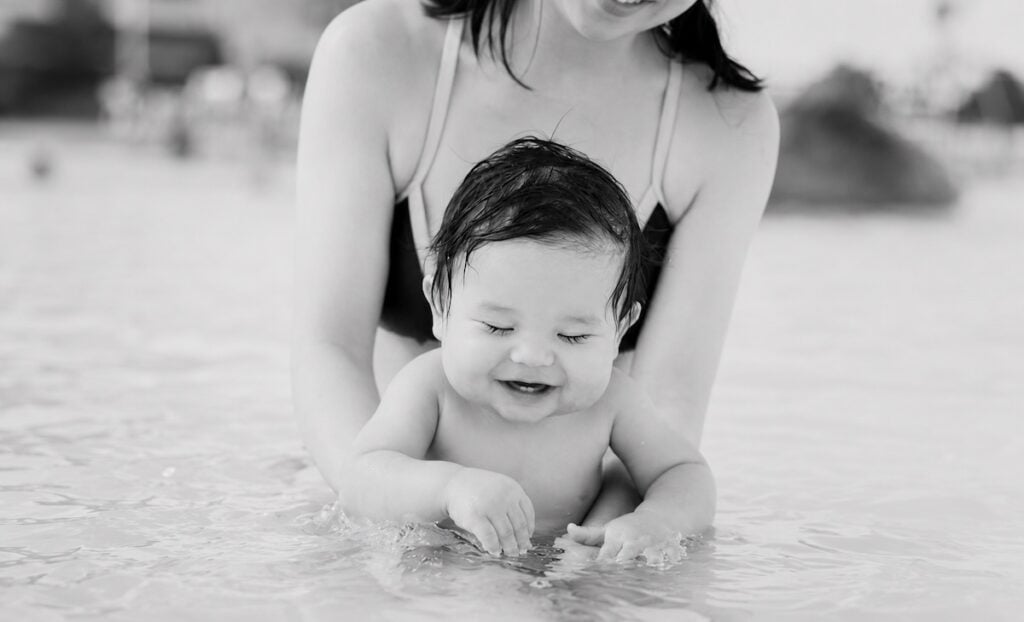
Are Baby Swim Lessons Worth It?
If you practice attachment parenting, you know the importance of making sure you’re always someone your baby can trust. And if you don’t feel confident in your ability to teach your baby to swim, finding a swimming instructor your family trusts is essential.
A parent-child class is often a successful introduction to the pool for your child, giving both parent and baby an opportunity to bond in the warm water.
Quality infant swim classes focus on water familiarity, safety, confidence, and creating positive experiences around water.
“Ensuring a physically and emotionally safe and relaxed experience for your baby or young child’s first experience in the swimming pool will set the stage for a long, satisfying relationship with the water,” explains swim instructor Kaitlin Gardner.
When Should Babies Start Swim Lessons?
Many parent-child swim programs welcome babies as young as six months old, though some programs begin even earlier.
The best age to start depends less on a specific milestone and more on whether both parent and baby are ready for the experience. Before enrolling, be sure to consider:
- Can your baby comfortably hold their head up?
- Does your baby generally enjoy bath time and water play?
- Are you able to participate in the class with them?
- Is your child healthy and comfortable in new environments?
There’s no prize for starting early. If your baby isn’t ready at six months, they’ll still learn to love the water if you wait until nine months or a year.
What Gentle Baby Swim Lessons Look Like
Not all swim programs take the same approach. In a responsive, child-centered swim class, parents remain actively involved while babies gradually become comfortable with the water through songs, games, movement, and repetition.
Look for programs that:
- Encourage parent participation
- Move at a pace that feels comfortable for the child
- Focus on water safety and confidence
- Use play-based learning
- Respect children’s emotional responses
The best instructors understand that trust and confidence cannot be rushed.
How to Choose the Right Swim Class
Every child is different, but there are a few signs that a swim program is likely to be a good fit.
Green Flags
- Parents are welcome in the water with their babies
- Instructors explain skills before introducing them
- Children are encouraged but not pressured
- Lessons feel playful and engaging
- Instructors respect a child’s hesitation
Red Flags
- Children are expected to ignore signs of distress
- Instructors use shame or pressure to achieve compliance
- Parents are discouraged from supporting nervous children
- The program prioritizes performance over comfort and safety
Preparing for Your Baby’s First Swim Lesson
A few simple steps can make the experience smoother for everyone.
Visit the Pool Ahead of Time
If possible, visit before your first lesson. Let your child observe the sights, sounds, and activity from a comfortable distance.
Swimming pools can be surprisingly stimulating. Echoing voices, splashing water, bright light, humidity, and unfamiliar smells can feel overwhelming to a baby who has never experienced them before.
A little familiarity goes a long way.
Choose the Right Time of Day
Try to schedule lessons when your baby is typically well-rested and fed.
Avoid times that overlap with naps or meals whenever possible. A tired, hungry baby will have a harder time enjoying any new experience.
Check the Water Temperature
Babies lose body heat more quickly than adults. A pool temperature between 78 – 84 degrees will ensure a smooth transition and ultimate comfort.
A comfortably heated pool can make the difference between a relaxed, enjoyable lesson and a stressful one. Most infant swim programs use warmer water specifically for this reason.
Follow Your Baby’s Cues
One of the most valuable things you can do during swim lessons is pay attention to your child’s signals.
Some swim instructors encourage kids to get their faces in the water from day one. Your little one may love it, but for some children, this is a deal breaker. And it’s really not a big deal. There are adults who swim their whole lives without intentionally putting their face in the water.
Make it fun, and be open to what the instructor says, but don’t insist if your child is truly afraid. The same goes for swimming lessons as a whole. Many kids take to the water right away. Others may need to ease into it over a series of weeks or months.
Your baby doesn’t need to accomplish every skill on the first day… or even during the first month. Consistent positive experiences matter far more than checking off milestones.
How Long Should Babies Stay in the Water?
For young babies, 20 minutes in the water is plenty. Your toddler may want to stay anywhere from 30 minutes to an hour. Always follow your child’s cues.
It’s far better to leave them wanting more than struggle with a child who has reached their limit for being comfortable in the water before the class ends.
One of the easiest ways to help children develop a lifelong love of swimming is to end while they’re still having fun.
Swim Lessons Are Only One Part of Water Safety
While swim lessons can help children become more comfortable in the water, they are not a substitute for supervision.
Drowning can happen quickly and quietly, even for children who have participated in lessons.
Layers of protection — including active supervision, pool barriers, life jackets when appropriate, and ongoing water safety education — remain essential throughout childhood.
The Real Goal of Early Swim Lessons
When we think about swim lessons, it’s easy to focus on skills: floating, kicking, blowing bubbles, or eventually learning strokes.
But the most important outcome may be something less visible.
A child who feels safe in the water is more likely to become a confident swimmer. A child who trusts the adults supporting them is more willing to try something new. And a positive first experience can shape the way they feel about swimming for years to come.
The goal isn’t to create the youngest swimmer in the pool.
It’s to help your child build a healthy, confident relationship with the water.