
How Blue Light Affects Toddlers’ Sleep (and What to Do at Night)
“I’m typing this from my child’s bed…” is something we often see in reader emails and late-night social media posts. A parent, lying beside a wide-awake toddler, scrolling for answers while waiting (or praying) for sleep to come.
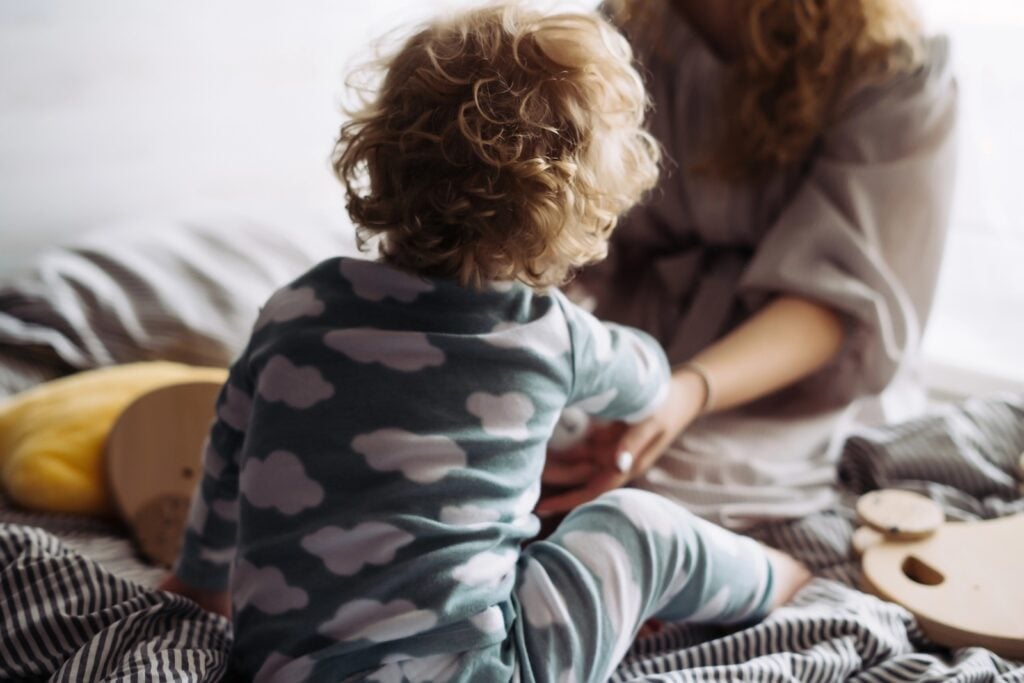
Sleep deprivation can take a toll on the entire family. For kids, it can show up as anything from being cranky to full-on health issues. And for parents, nothing leads to poor decision-making and short tempers faster than waking up exhausted, knowing you have another full day to face without getting an adequate break for your brain and body.
In the quest to try every sleep hack or promising new product, it’s possible we’re overlooking something so simple it seems insignificant: Take a moment to consider what the light looks like in your home after sunset:
- Is your child going from a room with bright LED lights or a TV straight to bed 15 minutes later?
- Are you reading their nightly bedtime story by an overhead light or practicing one of our guided meditation scripts from your phone?
- Is there a bright white nightlight in your child’s bedroom?
- Do you stay in their room or bed scrolling your phone until they fall asleep?
Growing research shows that even low levels of artificial light can influence how our bodies prepare for sleep. This is especially true for young children whose circadian rhythms are still developing.
How Circadian Rhythms Develop in Toddlers
Circadian rhythms run the body’s internal clock. They are the systems that help regulate sleep, wakefulness, hormone release, and energy levels over a 24-hour cycle.
In adults, this rhythm is relatively stable. But for babies and toddlers, it’s still maturing.
Newborns don’t yet have a strong day-night rhythm. Over time, exposure to natural light during the day and darkness at night helps their bodies begin to understand when it’s time to be awake and when it’s time to rest.
By the toddler years, this rhythm is more established, but still sensitive.
That means environmental cues, especially light, play a powerful role in how easily a child can fall asleep and stay asleep. Natural daylight via more time outdoors helps reset your child’s circadian rhythm. This in turn helps them go to sleep earlier and sleep longer, as well as get higher-quality sleep.
Why Evening Light Matters More Than We Think
As evening approaches, the body naturally begins producing the sleep hormone melatonin. This rise in melatonin helps signal that it’s time to wind down.
The wrong types of light exposure can interrupt that process.
Research on circadian rhythms shows that light is the body’s strongest cue for sleep and wake cycles. In the evening, lower light levels allow the brain to release melatonin, the hormone that helps us feel sleepy.
Studies have found that artificial light at night can delay this process. Children may be even more sensitive to these effects, since their eyes take in more light and their internal rhythms are still developing.
Bright light, and especially the blue wavelengths emitted from screens and LED bulbs, can suppress melatonin production and delay sleepiness. For toddlers, this effect can be even more pronounced. In simple terms, their bodies are still learning the difference between day and night. Artificial light can blur that signal.
This doesn’t mean a single light source will “ruin” sleep. But when multiple small sources of light are present, they can add up in ways we don’t always notice.
But circadian rhythms are only part of the story. Light also affects the nervous system more directly.
Light as a Nervous System Signal
Light doesn’t just help us see. It also sends powerful signals to the nervous system.
From the moment light enters the eyes, it communicates directly with areas of the brain that regulate alertness, hormones, and emotional state. In simple terms, light helps tell the body whether it’s time to be awake, aware, and active… or calm, safe, and ready to rest.
Certain types of light, especially bright or blue-toned light, increase alertness and raise stress hormones like cortisol. This is helpful during the day when we need energy and focus.
But in the evening, those same signals can work against sleep.
Warm, dim light — similar to sunset or firelight — sends a very different message. It tells the nervous system that the day is coming to a close. This allows the body to shift into a more relaxed, parasympathetic state, where rest, digestion, and sleep can occur.
For toddlers, whose nervous systems are still developing, these signals can be even more influential. When the body receives mixed messages — tired, but still exposed to bright or stimulating light — it can make it harder to fully settle.
The Hidden Light Sources in a Toddler’s Room
When bedtime feels like a struggle, we often look at routines, naps, or behavior. But light exposure is one of the easiest factors to overlook.
Here are some common sources of evening light:
- Phones and tablets
Even a quick scroll while sitting beside your child can introduce bright, stimulating light into the room. - LED nightlights
Many standard nightlights emit cool, bluish light rather than the warm tones our bodies associate with sunset. - Hallway light spill
Light from outside the room can subtly brighten the sleep environment. - Overhead lighting during bedtime routines
Bright bathroom or bedroom lights before bed can delay the body’s natural wind-down. - Television or background screens
Even if a child isn’t watching directly, ambient light still reaches their eyes.
These are all part of modern living. Most of us don’t think of these as factors that might be overstimulating our child at bedtime.
Creating a Circadian-Friendly Bedtime Environment
You don’t need a perfectly dark, screen-free home to support your child’s sleep. Small, thoughtful shifts can make a meaningful difference. Just as bigger kids need their own mindfulness sleep routines to settle from a busy day, small children can really benefit from a few minor adjustments.
Here are a few gentle ways to align your evening environment with your child’s natural rhythms:
Use warm, dim lighting in the evening
As bedtime approaches, begin lowering light levels throughout the home. Soft lamps or warm-toned bulbs can help signal that the day is ending. Try to limit the use of overhead lights. In nature, evening light comes from low angles — like the setting sun or a fire close to the ground.
Choose red or amber nightlights
A nightlight can be a helpful safety measure. Look for options that emit red or amber light rather than blue or white light. These are less likely to interfere with melatonin.
Limit screen exposure before bed
Turn off screens at least an hour before bedtime. Make bath time a calming experience. Read a book together by lamp light and try to reduce any overstimulating activities or toys. If you use our guided meditation scripts for sleep, print the PDF or read it from a device that isn’t backlit.
Keep the sleep environment gently dark
Northwestern University researchers found that people exposed to even a moderate amount of light while they slept experienced higher heart rates compared to when they slept in a very dark room. This may also be the case for small children, so try to keep light as minimal as possible. Blackout curtains can support deeper sleep and prevent early morning light from waking your child too soon.
Be mindful of “in-the-moment” light
If you’re sitting with your child while they fall asleep, try not to use your phone. In addition to being the wrong type of light, it can be distracting and stimulating. If you must use it, turn it to dark mode or change the color settings to a warm or red filter.
Supporting Sleep Without Pressure
If you’ve read this far and are thinking this is too simple to make a difference, adjusting the light around your home is worth a try. You don’t have to buy anything new, just cut out the screens and blue lights at least an hour before bedtime. You’ll be able to tell if it’s helping within a week or so.
Toddler struggles and meltdowns are rarely caused by just one thing. Developmental changes, separation anxiety, overtiredness, and daily stimulation all play a role in a small child’s ability to fall asleep easily.
Light is one piece of the puzzle.
The goal isn’t to create perfect conditions or add pressure to your evenings. It’s to become aware of small environmental factors that can support your child’s natural rhythm. Simple adjustments like dimmer lights, fewer screens, and a softer transition into night can help bedtime feel calmer.
More Toddler Sleep Resources
How to Help Your Child Settle at Bedtime
The Benefits of Toddler Floor Beds
8 Guided Meditations for Sleep
How Time Outdoors Resets the Circadian Rhythm for Better Sleep
Better Sleep Can Improve Attention Deficits
Want Happier, Calmer Kids? Simplify Their World.