
Josée Bergeron on Beyond the Front Door and Raising Nature-Connected Kids
With her new book Beyond the Front Door: Embracing Nature for a Healthier and Happier Family, Josée Bergeron of Backwoods Mama is inviting families to step back into a more connected, nature-centered way of living. We spoke with Josée about nature connection, seasonal rhythms, screen balance, and how small daily moments outdoors can transform family life.
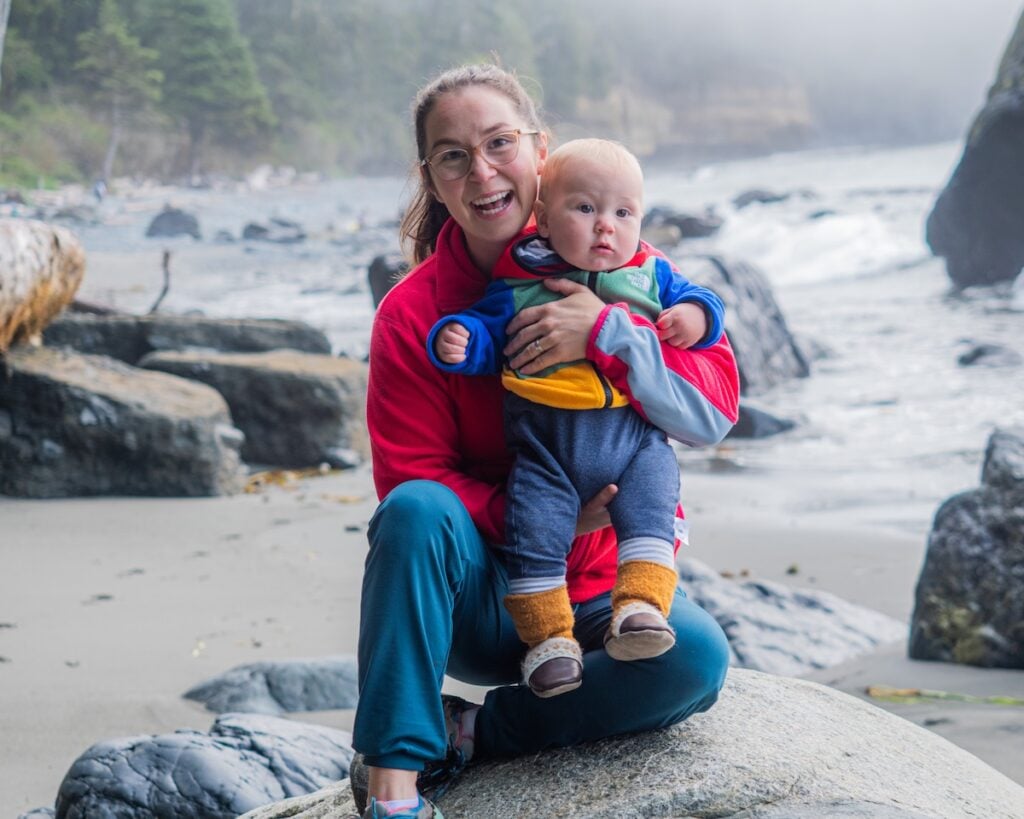
Our Interview with Josée Bergeron
Amity Hook-Sopko: Congratulations on your first book! You describe Beyond the Front Door as a guide to making it easier for families to get outside with kids. Can you tell us what inspired this book and what you hope families take away from it?
Josée Bergeron: Thank you! Yes, this book was ultimately inspired by the many adventures and misadventures of getting my five kids outdoors, all while juggling modern parenting realities like screen time, busy schedules and even access to nature. What I’ve noticed as a parent is that getting outside, even in simple ways, has really helped my children and me thrive. Our family feels happier and healthier!
As I tapped into my nursing background and dove into the research, I kept seeing the same thing: connecting with nature, even nature close to home, can have a positive impact on kids’ and parents’ health and wellbeing. That’s why I wrote Beyond the Front Door to be a blend of personal storytelling, guidance informed by research, and practical ideas families can actually use. My hope is that this book helps busy, over-scheduled families find small moments to step outdoors, slow down, and build connection and a little more calm, season by season, wherever they live.
Amity: I love the combination of studies and practical life. Isn’t it wild we need studies to tell us nature is good for us?
Josée: I know! Professor Miles Richardson has a quote I love. He says: we don’t question whether fish need a river, birds need the sky or apes need the forest, yet we’ve spent millions trying to prove people benefit from nature.
It’s kind of silly…and kind of telling. But the research is clear, and is our lived experience, we thrive when we feel connected to the natural world.
Quality Over Minutes Outside
Amity: It’s tough today to think about so many kids being stuck inside and missing the wonder of nature. Even more than the built-in health benefits, it’s the loss of developing intuition, patience, and their creativity.
Josée: Yeah, when parents think about nature, there’s often this general sense of, “We know it’s good for kids to get outside.” And it really is! There’s a lot of research showing benefits for children and adults – the light, movement, fresh air.
But I notice parents get stuck on the time bit: “How many minutes a day?” or “I don’t have time.” And the truth is, the research doesn’t give us one magic number. More time can help, of course, but what matters just as much is the quality of the moment—the wonder, the noticing, the creativity and curiosity.
That’s why in my book I take it a step further and look at the science of nature connection. That’s where intuition, patience, and creativity really flourish for children and parents. We can start to embrace the lessons that nature can teach us. We can even co-parent with nature.
Children can see their own strengths reflected back in the natural world, and as parents we feel supported, too. And when we focus on connection—with nature and with each other—even small blocks of time, when they’re meaningful, can have a big impact.
The Role of Unstructured Outdoor Play
Amity: I also think it’s helpful for parents who are trying to “fit this in” to their day to hear that small, meaningful moments in nature still count and are still beneficial.
Because you can’t just tell families to “go outside and play” if that hasn’t been part of their life. You can’t just put kids outside and expect them to magically know what to do or not feel bored. But when it’s intrinsic — when you’ve grown up around trees, or even when you’ve just had a small backyard in a subdivision — you start to build your own rhythms and ways of being outside.
Josée: Exactly. And parents are key. Research shows parents hold the biggest influence on a child’s connection with nature. Even forest schools can’t replace what happens at home.
The first step is helping parents feel confident going outside themselves. Then taking small steps with children, like walking to school instead of driving, noticing birds, watching leaves change, observing seasons. Parents need to know it can happen close to home.
Unstructured outdoor play is also critical. Families don’t need to travel far. Backyards, parks, and local trails are enough. Social media can make parents feel like they need elaborate outdoor adventures, but that’s not necessary.
Amity: Right. Kids like familiarity.
Josée: They do. And boredom is healthy. When kids say they’re bored, I usually respond, “I can’t wait to see what you do with that.” It creates space for imagination. Kids need permission to get messy, to explore mud, loose parts, and unstructured play.
Sometimes parents feel pressure to constantly play with their kids, but real play often happens best when adults step back. When adults enter play, we often start unintentionally controlling. And if play feels like “too much” indoors, bring it outdoors!
Nature can handle mess and noise. It also provides important sensory input — touching rocks, sticks, dirt. That physical contact is key for building connection and development.
Supporting Nature-Averse Kids
Amity: Do you have advice for nature-averse kids?
Josée: As we become more disconnected from the natural world as a society, we’re seeing more biophobia—fear of nature. There’s a level of biophobia that would be considered sort of evolutionarily normal — like snakes and spiders—but we’re definitely starting to see biophobia show up in more extreme ways such as children and adults being afraid of butterflies!
I would say the first step to helping a nature-averse child is to reflect back on ourselves as parents and our own relationship with the natural world. Children will often reflect and learn from us. So, it’s a really good starting place to ask, “What is my own relationship with nature? How do I react outdoors? What messages am I sending without realizing it?”
That might not always be the root of it, but I think it’s an important place to begin. Another piece is just providing lots of opportunity for children to interact with the natural world in ways that feel safe for them. That can even mean bringing nature indoors.
If we’re out walking and find leaves or pinecones, setting up a little nature table, having a loose-parts bin with natural items — bringing it inside and making it more familiar — that can be really helpful for some kids.
A lot of children are afraid of bugs. But there are ways to help children gently overcome those fears and even learn to love what Nicolette Sowder calls “the unloved things.”
Books are super helpful and we are really fortunate to live in a time when there are so many beautiful picture books for children. If my kids have questions, curiosity, or even fears about certain things in the natural world, I’ll just start pulling books from our local library, and we’ll read about it together.
Stories, Culture, and Identity in Nature
Amity: Yes! Books always reinforce that spark. When our boys were little, I loved helping them take their curiosity to the next level with the library, planetarium, or Youtube videos. They still do it now.
Josée: Yes, I’ve found that really helps. Parents can also tell stories from their own childhood in nature, which can be incredibly empowering for kids.
For me personally, I’m Métis — one of the three distinct Indigenous Peoples in Canada — and my father grew up in Manitoba. The stories he shared with us when we were kids really shaped how I see nature and my relationship with it.
And then there’s the sensory piece. I have a child like that. Pumpkin carving is a perfect example:it’s like, “No, thank you. I’m not touching those guts.” I don’t believe in forcing children. But I do believe in providing lots of opportunity and modeling comfort. So I’ll dig in. I’ll touch the pumpkin guts. I’ll make the mud pie. And over time, seeing that it’s safe can help kids feel more comfortable.
Screens, “Extinction of Experience,” and Healthy Boundaries
Amity: Do you talk about screens in your book?
Josée: There is a section where I talk about something called the “extinction of experience.” So it’s essentially this idea that we’re becoming more disconnected from the natural world because we have fewer real-life experiences and fewer opportunities to connect with it. I talk about different reasons why that’s happening, and screens are one of the big ones.
When we’re constantly connected to screens, we end up disconnecting from the natural world. And kids are spending a lot of time on screens. The statistics around that are pretty intense.
Screens also have this way of skewing how children perceive the world around them, especially the natural world. That’s another concern when it comes to screen use.
I take the position, as a parent, that screens are a tool. They can be helpful for certain things, but I think we need to set healthy boundaries around that tool. I encourage parents to seek age-appropriate guidance on screen time and make healthy, informed decisions for their own families.
Following Your Child’s Lead Outdoors
Amity: My boys used to spend all day outside playing with the neighbor kids. They’d take an occasional popsicle or video game break, but they always needed outside time to burn off that rowdy energy.
Josée: Exactly. I try not to guilt parents. There’s already enough pressure. My book is about supporting parents with grace.
I have five kids, so I totally get it. Sometimes I’m doing laundry or trying to make dinner. I also have a four-year-old and a two-year-old, and sometimes I’m just like, “Okay… I just need a moment. You can watch a little bit of a show.” That’s life, but I always come back to healthy boundaries.
And I like to remind parents that screens can be used in positive ways, especially with older kids and teens. I’ve been working with a group of teens and learning about iNaturalist — using your phone to identify plants and animals in your area. You can actually participate in citizen science. Screens can be used in positive ways to draw older kids and teens into the natural world.
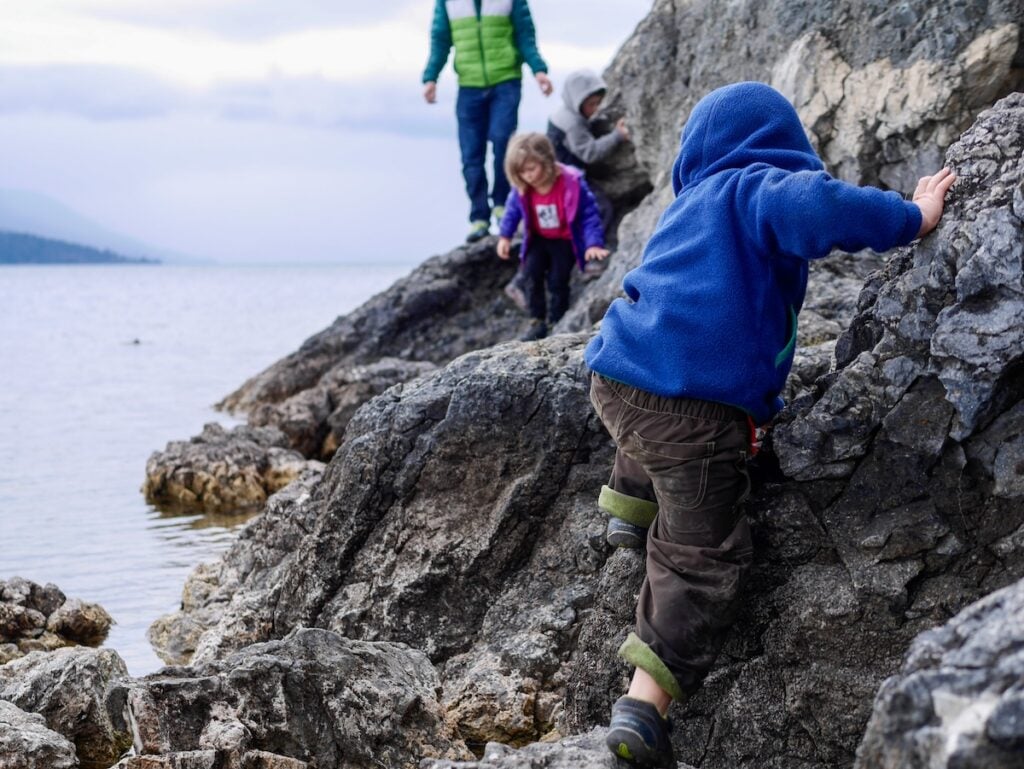
Mentally, that transition away from screens and out the door can feel huge. Sometimes it’s like an Olympic sport just to get my five kids outside. Once you’re out there, one of the best tips I share is to follow your child’s lead.
Even very young children have this amazing ability to notice things we tend to overlook. It’s wild. I’m constantly reminded of it. We’ll be walking along, just seeing the path, and suddenly my child will stop and say, “Oh, look at this slug,” or “Look at this flower.”
And if we can take that moment to wonder at nature alongside our child, they almost reteach us how to reconnect with the natural world. It’s such an amazing opportunity.
Your child hasn’t forgotten that language of nature connection. It still comes naturally to them, especially when they’ve had the opportunity to be outside. There are always exceptions, of course. But kids’ curiosity can really help guide the experience.
Amity: Do you think kids need a lot of outdoor toys or parent-directed activities?
Josée: My two-year-old loves dump trucks. But in my experience, kids can get overwhelmed by having too many toys. Sometimes less really is more. There are certain tools that are always tried-and-true with kids. I talk about mud kitchens in my book. You don’t need the Pinterest version. You can use a couple of cinder blocks and a board, or pick up some old kitchen items from a thrift store. You could spend five or ten dollars and basically have a whole outdoor kitchen.
As kids get older, I also love the idea of introducing real tools, like hammers. In my book, I talk about whittling, which is obviously for older children. Learning how to use a whittling knife safely can be really empowering.
Amity: That’s very Montessori-aligned.
Josée: It is. Kids love to use real tools. It makes them feel capable and trusted. And again, every child is different, but the natural world already provides so much to play with. You can have all the playground equipment, but kids will often wander toward the trees. Because trees give them so much — something to climb, sticks, leaves, shelter, imagination.
We can buy all the fancy toys, but kids often end up gravitating toward the simplest things. If you have just a few basic tools like a shovel and bucket, those can go a really long way.
Living Seasonally as a Family
Amity: Can you briefly share about the living seasonally aspect of the book?
Josée: At the beginning of each seasonal section, I invite families to tap into their own cultural seasonal beliefs and traditions. I’m not about telling people, “You should do all these things.” It can be as simple as paying attention to what you’re already doing and finding ways to connect those moments back to the natural world and the seasons.
We’ve really bought into the commercialization of the seasons, and because of that, we can lose connection to the deeper meaning of many celebrations. If you look back historically, a lot of cultural and even religious traditions are rooted in seasonal rhythms.
For children especially, having these seasonal touch points and celebrations help them feel connected to the natural world. That’s one of the reasons my book is structured by seasons.
Amity: I love that, because when you’re following the seasons, you’re more in tune with the natural world. You’re not pretending every day is the same — because in nature, it’s not.
Josée: Exactly. When we live primarily indoor lives, it’s easy to lose touch with what’s happening outside. Even something as simple as eating seasonally can reconnect us with the natural world. You start asking, “What’s growing in my area right now? What’s in season?”
That’s why I don’t just talk about getting outside. I also include things like recipes in my book, because even the food we eat and the water that comes out of our taps are part of this connection. When you start to really think about it, you realize how interconnected we are with the natural world. We just have to slow down and notice it.
Where to Find Beyond the Front Door
Josée Bergeron’s book Beyond the Front Door: Embracing Nature for a Happier and Healthier Family is available on February 24, 2026 by Morehouse Publishing. It’s available online at retailers like:
Amazon, Barnes & Noble, Indigo/Chapters
Or please support your local book store by having it ordered locally. You can also follow Josée at her website Backwoods Mama or Instagram.
Ideas for Getting Outside with Kids
Across Green Child’s website and throughout 15 years of our digital magazine, you’ll find ways to help your child feel at home in the great outdoors. Here are a few popular articles and activities:
Nature Scavenger Hunt Printables
DIY Organic Bird Feeder
How to Make Sun Print Art
Owling with Kids
Stargazing with Kids
Backyard Bug Count Activity
Fairy Garden Ideas for a Magical Backyard